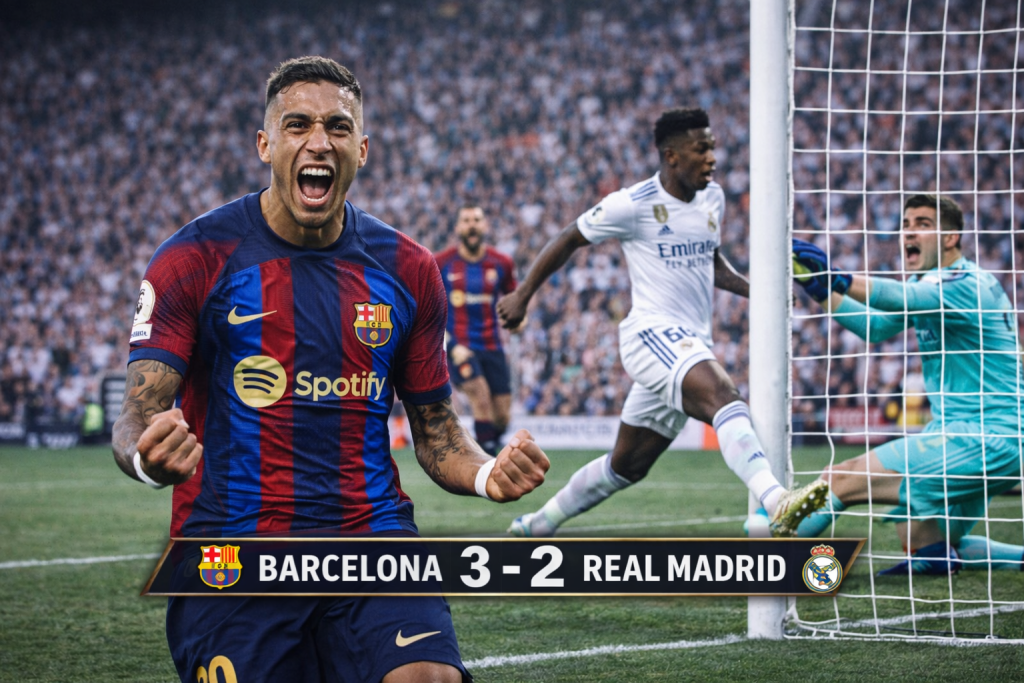
The latest edition of Barcelona versus Real Madrid delivered everything expected of a Clásico and more drama, quality, controversy, momentum swings, and a breathtaking five-goal storyline that kept fans on edge until the very last second. When the final whistle sounded, Barcelona emerged with a thrilling 3–2 victory, but the match itself felt like a battle that could have gone either way at multiple points.
From the opening minutes, Barcelona made their intentions clear. They dominated possession early, circulating the ball with confidence and pinning Real Madrid deep in their own half. Pedri, Lamine Yamal, and Raphinha combined fluidly, probing for openings while forcing Madrid’s midfield into reactive defending. Real Madrid, meanwhile, looked dangerous on the counter, relying on the explosive pace and directness of Vinícius Júnior and Rodrygo to threaten whenever space appeared.
The breakthrough arrived in the 36th minute and it was pure brilliance. Raphinha picked up the ball on the edge of the box, danced past his marker, and unleashed a sensational strike into the bottom right corner. Thibaut Courtois stood no chance as the ball kissed the net, and Barcelona’s dominance finally translated into a deserved lead.
Just as the match seemed to be settling, the closing moments of the first half exploded into chaos. In the 45th minute, Vinícius Júnior produced a moment of individual magic, gliding past defenders before finishing clinically into the bottom corner to level the score at 1–1. Barcelona barely had time to regroup before striking back. Pedri slipped a perfectly weighted pass through to Robert Lewandowski, who showed sublime composure to chip the ball over the goalkeeper, restoring Barcelona’s lead at 2–1.
Yet the drama wasn’t finished. Deep into stoppage time, Real Madrid won a corner, and after a scramble in the box, Gonzalo García reacted quickest to slot home a rebound off the crossbar. In a matter of minutes, the score swung twice, and the teams went into halftime locked at 2–2 after one of the most chaotic endings to a first half in recent Clásico history.
The second half began with relentless intensity. Real Madrid grew stronger, with Vinícius Júnior repeatedly testing Joan García, who produced a series of outstanding saves to keep Barcelona in the contest. One astonishing stop from point-blank range left Madrid players holding their heads in disbelief. At the other end, Barcelona continued to threaten through quick combinations and sharp movement, with Lamine Yamal and Dani Olmo finding pockets of space behind Madrid’s midfield.
The decisive moment came in the 73rd minute. Dani Olmo threaded a clever pass to Raphinha at the edge of the box. The Brazilian struck the ball first time, and a deflection wrong-footed Courtois, sending the ball into the net for his second goal of the night. At 3–2, the stadium erupted, fully aware that the match had reached its defining moment.
What followed was a tense, frantic final stretch. Real Madrid threw everything forward, introducing fresh attacking options and piling pressure onto Barcelona’s defence. Joan García produced another miraculous save from Álvaro Carreras, while Raul Asencio’s late header lacked the power to beat the goalkeeper. Tempers flared as yellow cards were shown freely, and Frenkie de Jong’s red card in stoppage time added even more tension to an already volatile atmosphere.
Despite being reduced to ten men, Barcelona showed resilience and composure. They slowed the game, managed possession intelligently, and resisted Madrid’s late surge. Even with corners and crosses flying into the box in the dying seconds, Barcelona held firm, clearing their lines and protecting their narrow lead with determination.
When the referee finally brought the match to an end, it confirmed a dramatic 3–2 victory for Barcelona in a Clásico that will be remembered for its intensity, momentum shifts, and sheer quality. Raphinha was the standout figure with two crucial goals, but the result was built on collective effort, crucial goalkeeping, and decisive moments taken at the right time.
For Real Madrid, the defeat was painful but not without positives. Their attacking threat, particularly through Vinícius Júnior, caused constant problems, and on another night, the outcome could easily have been different. In the end, however, Barcelona’s ability to strike at key moments and survive immense late pressure made the difference in a match that lived up fully to the legendary status of El Clásico.