The encounter between Nigeria and Algeria unfolded as a game shaped by patience, control, and ruthless efficiency rather than constant end-to-end chaos. From the opening whistle, Nigeria looked purposeful, confident on the ball, and clearly prepared to absorb pressure before striking at the right moments. Algeria, on the other hand, tried to impose themselves through possession and width, but often found Nigeria’s structure difficult to break down.
Nigeria started the match with early intent, pressing high and winning set pieces in dangerous areas. Ademola Lookman and Alex Iwobi were lively in the opening minutes, combining well and forcing Algeria into defensive clearances. Semi Ajayi came close early on with a header from a free kick, while Frank Onyeka and Akor Adams added energy and physicality in midfield and attack. Algeria had moments of calm possession, but Nigeria’s defensive organisation ensured that most crosses and long balls were dealt with comfortably by Stanley Nwabali.
As the first half progressed, Nigeria increasingly looked the more threatening side. Victor Osimhen’s movement constantly unsettled Algeria’s back line, creating pockets of space for runners from deep. Ademola Lookman nearly opened the scoring from close range, only to be denied by Luca Zidane, who was forced into several sharp saves to keep Algeria level. Nigeria’s dominance was reflected in their growing number of attempts, even though the breakthrough refused to come before halftime.
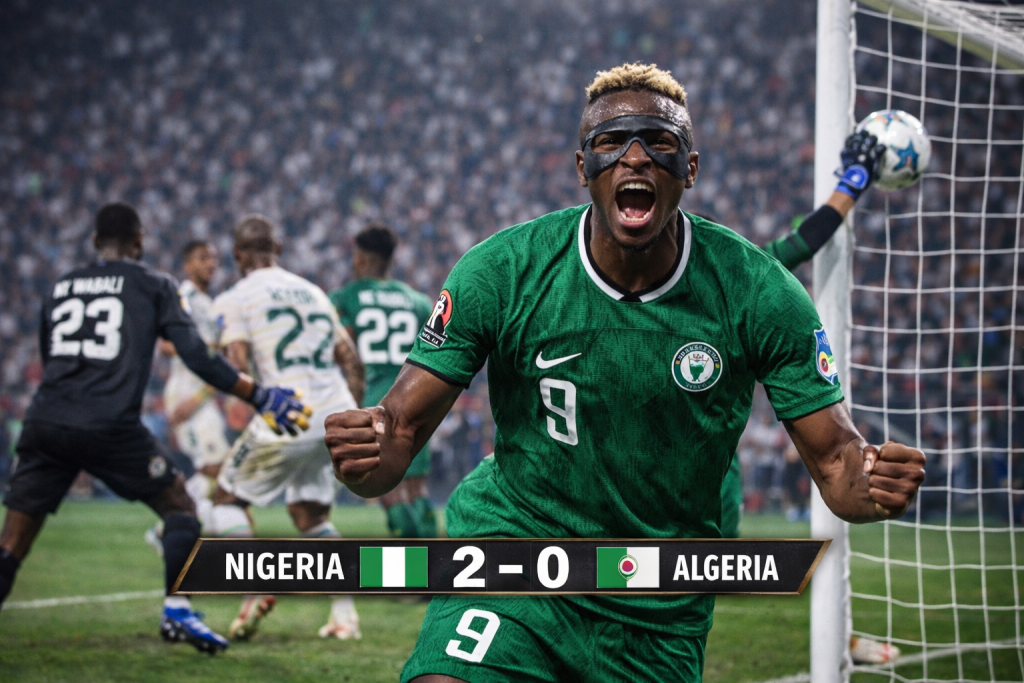
The second half told a very different story. Nigeria emerged with greater urgency and clarity, and their pressure finally paid off just two minutes after the restart. Bruno Onyemaechi delivered a dangerous cross that evaded the goalkeeper, leaving Victor Osimhen with a simple header from close range. The goal was a reward for Nigeria’s persistence and immediately shifted the balance of the game.
Algeria attempted to respond by introducing fresh legs and pushing players forward, but this only opened up more space for Nigeria on the counterattack. Osimhen continued to lead the line intelligently, holding up play and bringing teammates into the game. In the 57th minute, Nigeria struck again with a move that perfectly captured their efficiency. Osimhen slipped a smart pass through to Akor Adams, who calmly outwitted the goalkeeper with a clever dummy before lifting the ball into the net. At 2–0, Nigeria were firmly in control.
From that point on, the match became increasingly fragmented. Injuries, substitutions, and fouls disrupted the rhythm as Algeria searched desperately for a way back into the contest. Nigeria, meanwhile, managed the game intelligently, slowing the tempo when needed and maintaining their defensive discipline. Stanley Nwabali was rarely troubled, confidently dealing with crosses and long-range efforts whenever Algeria threatened.
The final minutes were marked more by tension than by clear chances. Yellow cards were shown, fouls accumulated, and added time stretched the nerves, but Nigeria never truly looked like surrendering their advantage. Even as Algeria pushed players forward, Nigeria’s back line remained compact, blocking passing lanes and clearing danger efficiently.
When the referee finally blew for full time, it confirmed a professional and well-earned victory for Nigeria. This was not a win built on constant attacking flair, but on balance, composure, and clinical finishing at crucial moments. Victor Osimhen’s influence was undeniable, both as a goalscorer and a provider, while the collective discipline of the team ensured that Algeria were kept at arm’s length throughout the match.
In the end, the scoreline reflected Nigeria’s superiority on the day. They took their chances, protected their lead intelligently, and demonstrated a level of maturity that will encourage supporters. Algeria, despite spells of possession and effort, were unable to find the sharpness needed in the final third, leaving them frustrated as Nigeria walked away with a deserved 2–0 victory.