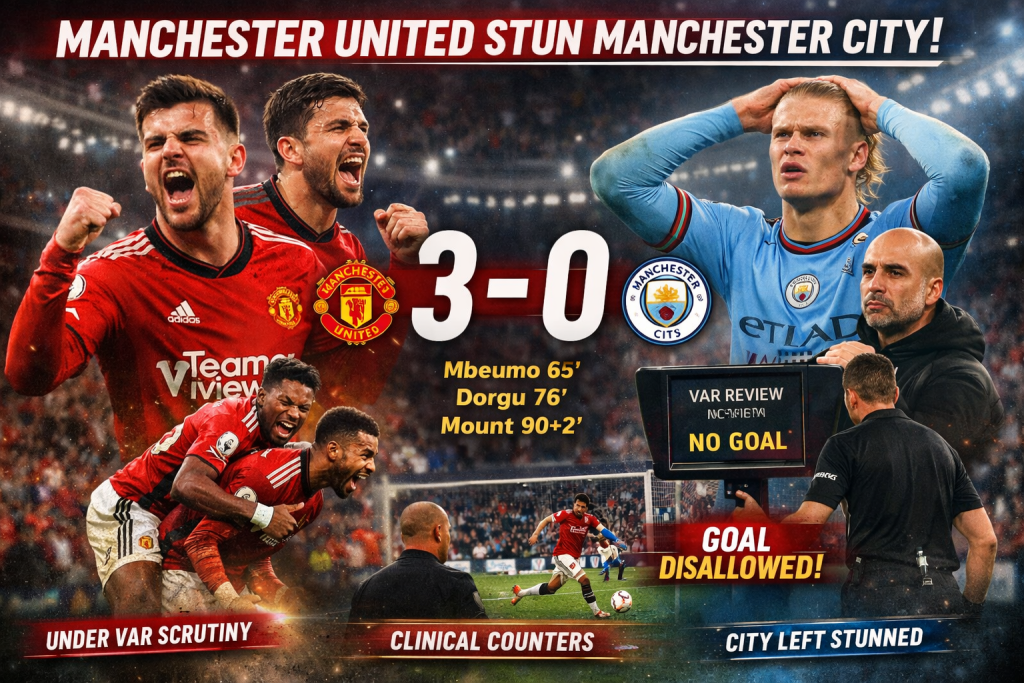
Manchester United delivered a derby performance that will be remembered not just for the emphatic 3–0 scoreline, but for the control, resilience, and ruthless efficiency they showed against Manchester City in a match overflowing with controversy, VAR drama, and decisive moments.
From kickoff, the tactical contrast was clear. City monopolised possession, circulating the ball patiently across midfield and defence, while United were comfortable without it.
Rather than pressing high and leaving spaces, United sat in a compact shape, protected the central areas, and focused on springing forward at pace whenever City lost the ball. This approach immediately unsettled City’s high defensive line and created danger far earlier than the scoreline suggested.
United should have gone ahead inside the opening minutes when Harry Maguire rose highest from a corner and sent a thunderous header crashing against the crossbar. It was a warning City failed to heed. Although City responded with long spells of possession, their dominance rarely translated into clear chances. United’s defensive structure held firm, forcing City into speculative efforts from distance or crosses that were dealt with calmly.
The first half soon descended into chaos as VAR became the central talking point. United thought they had broken the deadlock on more than one occasion. Amad Diallo found the net, only for celebrations to be abruptly halted as the referee was summoned to the screen.
The goal was ruled out for offside in the build-up. Moments later, Bruno Fernandes appeared to score, triggering wild celebrations, but once again VAR intervened, disallowing the goal after another lengthy review. The frustration among players and supporters was palpable, yet United showed impressive mental strength, refusing to lose focus or discipline.
City, meanwhile, grew increasingly frustrated. Despite controlling possession, their attacking play lacked incision. Erling Haaland had moments where he threatened from the edge of the box, while Bernardo Silva and Jeremy Doku tried to inject creativity from wide areas, but United’s back line remained organised and alert. Whenever City pushed men forward, United looked capable of punishing them on the break.
The second half followed a similar pattern, but this time United’s patience finally paid off. In the 65th minute, a lightning-fast counterattack cut City open. Bruno Fernandes, pulling the strings from midfield, released Bryan Mbeumo with a perfectly timed pass.
Mbeumo showed composure beyond his years, striking a first-time finish past the goalkeeper to make it 1–0. The goal was a reward for United’s persistence and tactical discipline.
City attempted to respond immediately, committing more players forward and increasing the tempo. However, this only created more space for United to exploit. Eleven minutes later, United struck again with a moment of pure quality. Matheus Cunha, recently introduced, played a clever ball into the box, where Patrick Dorgu met it with a spectacular volley.
The ball struck the post and bounced into the net, leaving the goalkeeper helpless and sending Old Trafford into raptures. At 2–0, the momentum had completely swung.
As the match wore on, City looked increasingly desperate. Their possession remained high, but confidence drained with every blocked shot and misplaced pass. Substitutions from Pep Guardiola failed to change the rhythm, and United’s defence continued to repel everything thrown at them. Crucially, United never retreated into panic. Instead, they managed the game intelligently, slowing it down when necessary and breaking forward with purpose.
The final act came deep into stoppage time and perfectly encapsulated United’s night. With City throwing bodies forward in search of a lifeline, United launched one last devastating counterattack.
Matheus Cunha carried the ball with composure before sliding a perfectly weighted pass to Mason Mount, who had just come on as a substitute. Mount made no mistake, calmly finishing from close range to make it 3–0. Even then, VAR intervened once more, checking for offside, but this time the goal stood, confirming a famous derby victory.
When the final whistle blew, the contrast between the two sides was stark. City had enjoyed the majority of possession, but United had mastered the moments that mattered. Their defensive discipline, ability to absorb pressure, and lethal counterattacking execution proved decisive.
For Manchester United, this was more than just three points. It was a statement of intent, a demonstration of tactical maturity, and proof that resilience and efficiency can overpower possession and control. For Manchester City, it was a sobering night, defined by frustration, VAR heartbreak, and a painful reminder that dominance without precision is often meaningless in football’s biggest matches.