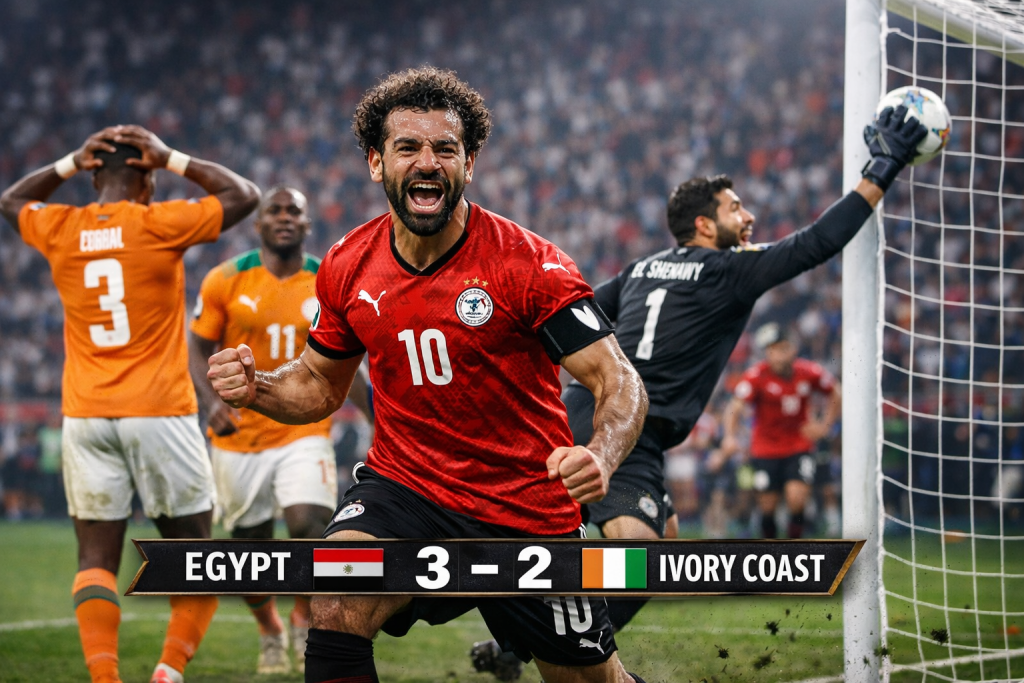
The clash between Egypt and Ivory Coast delivered everything football fans crave — early goals, momentum swings, individual brilliance, defensive lapses, and nerve-racking moments until the very last whistle. It was a match that never truly settled, as both sides pushed relentlessly, resulting in a dramatic 3–2 victory for Egypt.
The meeting between Egypt and Ivory Coast unfolded as one of those matches where the scoreline alone does not fully capture the emotional weight, tactical tension, and constant swings in momentum. From the very first whistle, it was clear that this would not be a slow-burning contest. Both teams approached the game with intent, urgency, and a clear understanding of what was at stake.
Egypt wasted no time stamping their authority on the match. In the fourth minute, a quick attacking move exposed Ivory Coast’s defensive shape. Emam Ashour’s awareness and timing opened up space for Omar Marmoush inside the box, and the forward showed composure beyond the early stage of the game by calmly finishing into the bottom right corner. That early goal did more than just put Egypt ahead; it forced Ivory Coast to abandon any cautious approach and commit to playing on the front foot much earlier than planned.
Ivory Coast responded by dominating possession, moving the ball with confidence across midfield and using the flanks to stretch Egypt’s defensive line. Amad Diallo and Yan Diomande were particularly active, delivering crosses and driving at defenders. Several corner kicks followed, each one increasing the sense that an equaliser could arrive at any moment. Evan Ndicka’s powerful header and Evann Guessand’s missed opportunity from close range were warning signs that Egypt could not afford to ignore.
Despite Ivory Coast’s control of the ball, Egypt remained disciplined. Their defensive structure held firm, and when opportunities arose, they looked dangerous. That balance between absorbing pressure and striking decisively became a defining theme of the match. It was evident again in the 32nd minute when Egypt earned a corner. Mohamed Salah’s delivery was precise, and Rami Rabia’s movement inside the box was perfectly timed. His header, placed beyond the goalkeeper, made it 2–0 and punished Ivory Coast for failing to convert their earlier dominance into goals.
The game seemed to tilt firmly in Egypt’s favour at that point, but football rarely follows a straight path. Ivory Coast continued to push, and their persistence finally paid off shortly before halftime. A dangerous free kick caused confusion in Egypt’s penalty area, and in the chaos, Ahmed Fatouh inadvertently diverted the ball into his own net. The goal was unfortunate, but it changed the complexion of the match completely. At 2–1, Ivory Coast went into the break believing that the game was still there to be taken.
The second half began with renewed intensity, and Egypt quickly showed that they were not content to sit back and defend a narrow lead. In the 52nd minute, Emam Ashour once again played a crucial role, threading a smart pass into Mohamed Salah. Salah’s finish was calm and clinical, a reminder of his ability to deliver when the pressure is highest. At 3–1, Egypt appeared to have restored control, but the scoreline was deceptive.
Ivory Coast refused to surrender. Their response was immediate and aggressive, with midfielders stepping higher up the pitch and defenders taking risks to support the attack. Franck Kessié came close with a powerful effort from distance, while Ibrahim Sangaré forced Mohamed El Shenawy into a brilliant save that kept Egypt’s two-goal advantage intact. As the minutes passed, the sense grew that Ivory Coast’s pressure might eventually break through.
That breakthrough came in the 73rd minute from yet another corner kick. Egypt failed to fully clear their lines, and Guela Doué reacted fastest inside the box, firing the ball into the net to make it 3–2. The goal transformed the final stages into a tense, frantic affair. Ivory Coast threw bodies forward, sending crosses into the box and winning repeated set pieces. Egypt, meanwhile, were forced deeper and deeper, relying on defensive resilience and the experience of their goalkeeper.
The closing minutes were filled with interruptions, substitutions, and moments that tested Egypt’s composure. Mohamed El Shenawy’s yellow card for time-wasting in stoppage time reflected just how intense the pressure had become. Ivory Coast continued to push until the very last moment, but Egypt held firm, clearing their lines and protecting their narrow lead with everything they had.
When the final whistle sounded, it brought relief for Egypt and frustration for Ivory Coast. The match told a story of efficiency versus dominance, of taking chances versus creating them. Egypt were ruthless in key moments, making the most of their opportunities and leaning on experience when it mattered most. Ivory Coast, despite the defeat, showed character, quality, and attacking intent that suggested they were unlucky not to come away with something.
In the end, this was not just a 3–2 result. It was a match defined by momentum shifts, emotional highs and lows, and fine margins that separated victory from disappointment. For Egypt, it was a reminder of the value of composure and clinical finishing. For Ivory Coast, it was proof that their attacking football can unsettle even the most organised opponents, even if the final outcome did not go their way.